Publishing one
You get a short link likeownsi.dev/p/8f2k91mx4c. Anyone with it can open it; nobody without it
can find it.
The link has its own random slug. It is never your DNS token — that stays between your account
and your zone, and on an ended claim it proves nothing anyway.
Ask for a link twice and you get the same one back rather than collecting duplicates. There is one
address per proof, and it stays that address.
What the person sees
What is on the page
The domain, the date it was proved, the masked address of the account that earned it
(
m•••@acme.com), the DNS provider, and the token that was found.What it does not do
It runs no DNS query when someone opens it. It reads one stored row and prints what that row
says — so it states the same thing today as the day you published it.
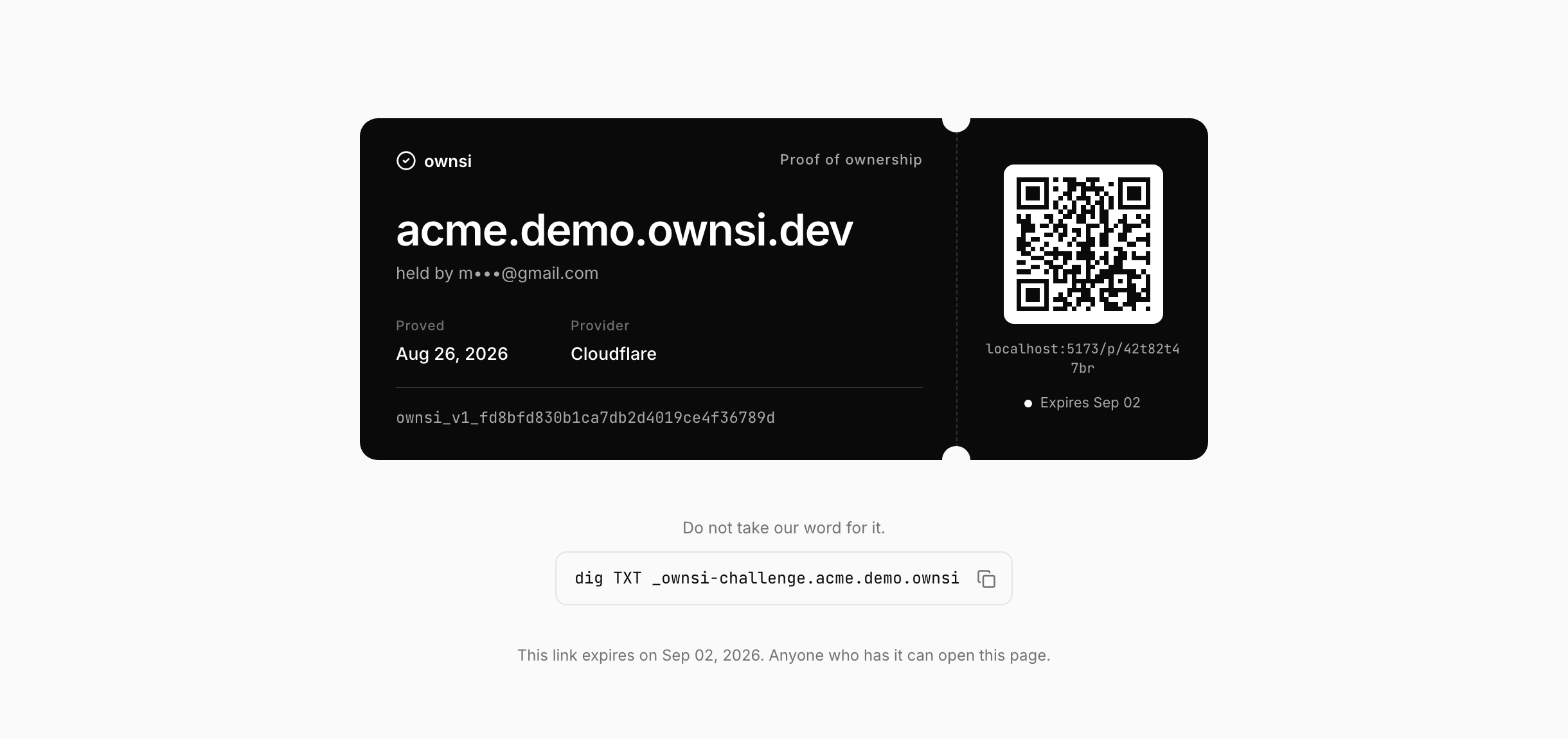
What opens on the other end. The address under the QR code is the link itself.
/p/:slug/badge.svg, for a README.
A link does not run down
Once published, it resolves until you take it back. Nothing about it expires on a clock. Expiry belongs to the other side of the claim: a claim that was never proved in time expires, because it was a question with a deadline. A proof answers the question, and the answer is about a moment that has already happened. A timer on the share would say nothing about the proof, so there is not one. That is what makes the address safe to paste somewhere permanent — a README, a site footer, an email signature.Taking one back
Revoking a link stops that slug resolving, immediately. What it does not do:- your proof keeps its date, and your domain still reads as proved;
- you can publish a new link a second later, and it gets its own slug;
- the old slug stays dead, permanently.
Every link you have published is listed, the revoked ones included. What has been shared is part of
the record, and hiding it from you would not un-share it.